Rheumatoid arthritis (RA) is a chronic, systemic autoimmune disease characterized by progressive joint inflammation, cartilage destruction, and long-term disability. Early and accurate diagnosis is critical to preventing irreversible structural damage and optimizing patient outcomes. Among the available biomarkers, Anti-Cyclic Citrullinated Peptide (Anti-CCP) antibodies have become one of the most reliable serological indicators for early RA detection.
Anti-CCP antibodies exhibit high specificity, often exceeding 95%, making them essential for distinguishing RA from other inflammatory joint disorders. Notably, Anti-CCP antibodies may appear years before obvious clinical symptoms, enabling clinicians to identify patients at risk even during the early or preclinical stages of disease. Their strong association with disease severity and prognosis also allows Anti-CCP levels to serve as a valuable tool for assessing potential disease progression.
As global awareness of RA continues to grow, healthcare institutions increasingly require testing solutions that offer precision, robustness, and adaptability across different laboratory environments. In response to these needs, Hotgen has developed a comprehensive portfolio of Anti-CCP assays powered by four complementary methodological platforms, ensuring accurate and accessible RA diagnostics for laboratories of all sizes.
Hotgen's Multi-Platform Anti-CCP Testing Technologies
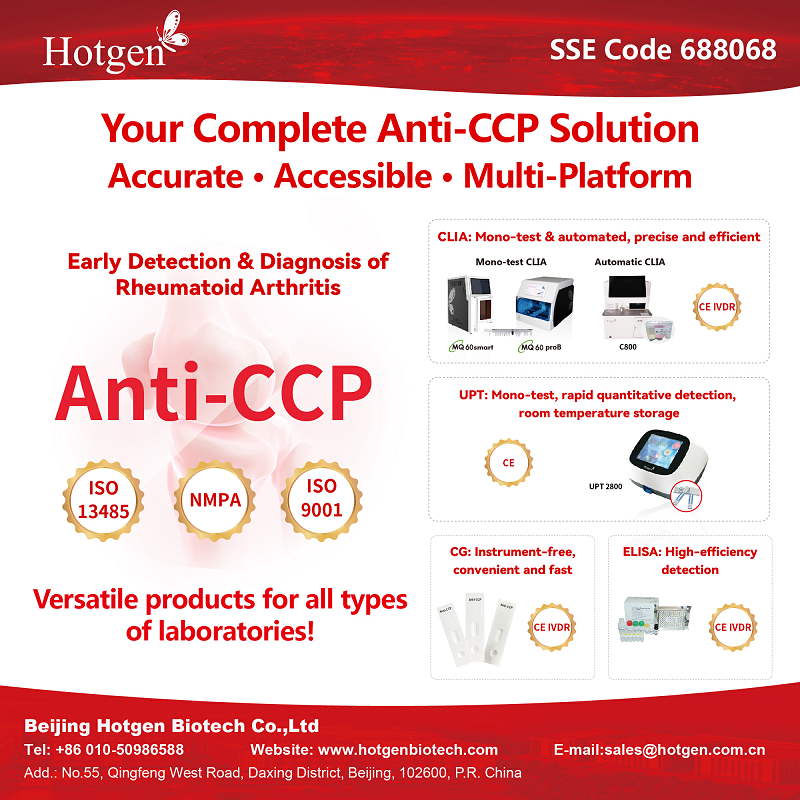
To address the diverse requirements of clinical laboratories, Hotgen provides four distinct Anti-CCP testing methodologies—Chemiluminescence (CLIA), Up-Converting Phosphor Technology (UPT), Colloidal Gold, and ELISA. Together, these platforms form a versatile diagnostic ecosystem that meets stringent performance standards while fitting a variety of laboratory workflows.
Up-Converting Phosphor Technology (UPT)
Hotgen's Anti-CCP UPT Assay is designed for fast, sensitive, and fully quantitative detection using an advanced luminescent system. The kit adopts a user-friendly, single-test format that supports testing on demand, allowing operators to perform tests immediately as samples arrive—without waiting for batch processing.
Key features include:
Full quantitative detection based on stable luminescent signal output
Single-test, individual-packaged reagents for maximum flexibility
Suitable for both individual testing and high-throughput workflows
Room-temperature storage, simplifying logistics and daily laboratory operation
This method meets the high efficiency requirements of hospital laboratories while maintaining excellent analytical performance.
Chemiluminescence Immunoassay (CLIA)
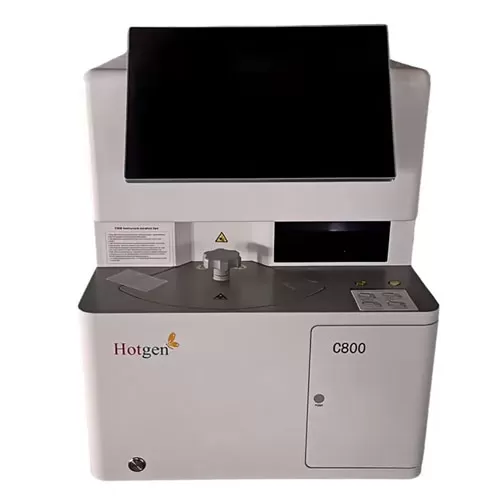
Hotgen's CLIA-based Anti-CCP assay provides a highly sensitive and automated testing solution ideal for medium-to-large laboratories. Chemiluminescence technology offers:
Wide linear detection range
High sensitivity suitable for early-stage RA patients
Automated sample processing and result interpretation
Stable, reproducible performance for routine clinical diagnostics
Colloidal Gold Immunoassay
For facilities requiring rapid screening, Hotgen's colloidal gold Anti-CCP test provides straightforward, visually interpreted results. This method features:
Simple operation without specialized instrumentation
Rapid result availability
Useful for preliminary screening or settings with limited equipment
ELISA Enzyme-Linked Immunosorbent Assay
Hotgen's Anti-CCP ELISA kit is widely used in clinical laboratories due to its robust analytical reliability and mature methodology. Key characteristics include:
High specificity and repeatability
Suitability for batch testing
Strong compatibility with standard microplate readers
Together, these four platforms ensure that healthcare institutions can select the most appropriate Anti-CCP assay based on workflow, sample volume, cost efficiency, and technological preferences.
Performance Advantages of Hotgen Anti-CCP Assays Across Four Methodologies
Hotgen's extensive Anti-CCP portfolio provides laboratories with performance advantages that align with international diagnostic standards. Each methodology is engineered to deliver sensitivity, stability, and accuracy—essential attributes for reliable RA diagnosis.
The UPT-based Anti-CCP assay stands out as a high-efficiency solution combining rapid detection with quantitative precision. Its single-pack format enables immediate testing, reducing delays linked to batch workflows. The ability to operate in both single-sample and high-throughput modes makes it adaptable to fluctuating test volumes, while room-temperature reagent storage simplifies transportation and long-term inventory management.
Hotgen's CLIA platform also excels by offering high sensitivity, broad linearity, and automated processing—ideal for laboratories managing high daily sample loads. Its ability to integrate seamlessly into existing laboratory automation improves operational efficiency and minimizes human error.
The colloidal gold method, though simpler in design, offers speed and convenience, supporting rapid decision-making in settings where immediate results are prioritized. Its accessible format expands testing availability without compromising basic diagnostic reliability.
Meanwhile, ELISA, a globally trusted methodology, provides consistent, high-specificity results suitable for large batch analysis. The stability and maturity of ELISA technology make it a dependable choice for institutions seeking standardized RA testing solutions.
Across all four methodologies, Hotgen ensures that accuracy, reproducibility, and clinical relevance remain the core priorities. Each platform undergoes rigorous validation based on professional clinical data, reinforcing Hotgen's commitment to delivering high-quality RA diagnostics worldwide.
 English
 français
 Deutsch
 Español
 ไทย
ไทย русский
 português
 العربية
 Indonesia